
Georgetown luxury real estate offers a scarce blend of historic architecture, riverfront living, and walkable access to Washington, DC's cultural core. For luxury home buyers, the value lies in owning a distinctive residence where provenance, renovation quality, outdoor space, and street position shape both everyday enjoyment and long-term appeal.
Restored rowhouses, private courtyards, terraces, discreet parking, and refined condominium residences create a market unlike newer suburban luxury enclaves. This guide explains the defining characteristics of this Northwest Washington, DC neighborhood's upper tier, its key micro-markets, buyer priorities, and ownership considerations.
Georgetown Luxury Market Overview
Luxury entry: This guide uses $650,000 as its luxury threshold, but in Georgetown much of the market sits well above it. In early October 2026, the Georgetown neighborhood overview showed a median sales price of $1,182,000 and an average sales price of $1,917,282. The practical luxury tier varies by property type, historic significance, condition, and location.
Value drivers: Renovation quality, usable outdoor space, parking, light, and architectural provenance often influence value more than square footage alone.
Inventory mix: The luxury segment includes historic rowhouses, townhomes, boutique condominiums, and select waterfront-oriented residences.
Marketing pace: Well-positioned properties can attract focused demand, while homes needing modernization or carrying ambitious pricing may require a longer marketing period.
Lifestyle anchor: River access, canal-side walks, established dining, independent retail, and Georgetown Waterfront Park support a highly walkable luxury lifestyle.
Georgetown Luxury Real Estate by the Numbers
| Metric | Figure | Source |
|---|---|---|
| Median sales price | $1,182,000 | Georgetown neighborhood page, October 2026 |
| Average sales price | $1,917,282 | Georgetown neighborhood page, October 2026 |
| Owner vs. renter occupancy | 52% owned, 48% rented | Neighborhood demographic data |
| Residential property tax rate | $0.85 per $100 of assessed value; $1.00 per $100 on value above $2.5 million for one- and two-unit homes | DC Office of Tax and Revenue |
| Deed taxes at sale ($400,000 or more) | 1.45% recordation plus 1.45% transfer | DC Office of Tax and Revenue |
| 2026 conforming loan limit (one unit) | $1,249,125 in the District of Columbia | Federal Housing Finance Agency |
The gap between the median and the average reflects how widely Georgetown sales range, from smaller condominiums to multimillion-dollar historic homes. Beyond these figures, the most useful luxury metrics are property-specific, because historic condition, block location, parking, outdoor space, and building services create substantial variation among otherwise comparable homes. Price per square foot can differ widely between historic rowhouses, renovated townhomes, and full-service condominiums, and days on market often reflect a home's presentation and modernization level as much as its price.
For financing, many Georgetown luxury purchases exceed the District's 2026 conforming loan limit of $1,249,125 for a one-unit home, which means jumbo financing with its own credit, reserve, and down payment expectations. Running scenarios through a monthly payment estimate early helps set realistic targets.
What Defines Luxury Real Estate in Georgetown
Georgetown luxury real estate is defined by architectural scarcity, exceptional condition, practical privacy, and a location that cannot easily be replicated elsewhere in Washington, DC. Rather than relying on one universal price floor, buyers should assess whether a home delivers the features that command a premium within its specific micro-market.
Luxury inventory commonly includes Federal and Victorian-era rowhouses, landmark-scale townhomes, elegant condominium residences, and homes near the river. Desirable features include restored millwork, high ceilings, upgraded kitchens, integrated security and smart-home systems, landscaped gardens, roof terraces, private courtyards, secure parking, and river-oriented views. In condominium buildings, service levels, private outdoor space, elevator access, and the quality of common areas can be equally important.
Georgetown's luxury character pairs central-city access with preserved residential texture. Many homes require buyers to weigh the quality of previous modernization against original architectural details. Georgetown is a federally protected historic district, and exterior work visible from public space generally goes through design review by the Old Georgetown Board of the U.S. Commission of Fine Arts, which can affect renovation planning, timelines, and design choices.
Georgetown University, the C&O Canal corridor, waterfront recreation, established retail streets, and dining destinations reinforce demand.
Premier Luxury Settings in Georgetown
Georgetown's premier luxury areas are best understood as distinct micro-markets, where street position, privacy, architectural significance, and modernization can materially affect a home's appeal.
East Village
The East Village, east of Wisconsin Avenue, is known for quieter tree-lined streets, substantial historic rowhouses, and a more residential setting near Georgetown's commercial core. Its luxury homes typically appeal to buyers who prioritize formal entertaining areas, garden space, architectural character, and discretion. The most desirable properties often combine period details with thoughtful contemporary upgrades.
West Village
The West Village, west of Wisconsin Avenue, offers cobblestone streets, a village-like atmosphere, boutique retail access, and proximity to both the riverfront and Georgetown University. Premium residences include renovated townhomes, period homes, and select condominium options. This area suits executives and lifestyle-focused buyers who value walkability, dining access, and a connected neighborhood setting.
Georgetown Waterfront
The waterfront is the preferred micro-market for buyers who prioritize river proximity, public green space, terraces, and a lock-and-leave ownership experience. Luxury condominiums and waterfront-adjacent residences can offer elevator access, managed building services, and outdoor living opportunities. According to the National Park Service, Georgetown Waterfront Park runs along the Potomac River from 31st Street NW to Key Bridge and was completed in fall 2011, with a car-free path for walkers, cyclists, and skaters.
Northern Georgetown's Elevated Blocks
The higher residential blocks in northern Georgetown can provide a quieter setting, multi-level layouts, and landscaped outdoor areas while remaining close to neighborhood amenities. Historic homes here often attract move-up buyers and families upgrading to a larger home who want more flexibility for work, entertaining, or long-term household needs without leaving the neighborhood.
Georgetown Luxury Settings Compared
Georgetown luxury areas differ primarily by housing style, street-level setting, privacy, and lifestyle priorities rather than by uniform averages.
| Setting | Typical Home Type | Defining Character | Best Suited For |
|---|---|---|---|
| East Village | Historic rowhouses and formal townhomes | Quieter streets, garden space | Buyers seeking formal historic homes |
| West Village | Renovated townhomes and period homes | Cobblestone streetscapes, walkability | Lifestyle-focused buyers and executives |
| Georgetown Waterfront | Luxury condominiums | River proximity, terraces, building services | Lock-and-leave and downsizing buyers |
| Northern elevated blocks | Larger multi-level historic homes | Quieter, more secluded residential feel | Move-up buyers and growing households |
Why Luxury Buyers Choose Georgetown
Luxury buyers choose Georgetown because it combines historic residential character, urban convenience, institutional presence, and river access in a compact, established neighborhood. The result is a luxury market where daily lifestyle value can be as important as interior finishes.
Georgetown University is a major local institutional anchor, with its Hilltop Campus located within the neighborhood. The area also provides walkable access to restaurants, independent shops, galleries, canal paths, and waterfront recreation. These amenities support a lifestyle that is difficult to recreate in lower-density luxury settings.
The strongest homes balance heritage with practical modern living. Buyers commonly place a premium on updated systems, flexible rooms, functional kitchens, private outdoor space, parking, and carefully preserved original details. Georgetown generally offers less land and fewer newly built homes than suburban luxury settings, but it provides a concentrated walkable environment and an established streetscape. The waterfront adds another layer of appeal, with public open space, river views, and nearby paths that complement the neighborhood's historic character.
Luxury Real Estate as an Investment in Georgetown
Georgetown luxury real estate can support a long-term ownership strategy because much of its appeal rests on attributes that are difficult to reproduce: historic architecture, constrained streetscapes, riverfront proximity, and central access to Washington, DC amenities. The investment case is usually strongest when a buyer selects a property with durable physical appeal and practical functionality.
A carefully restored home on a desirable street, with useful outdoor space and parking, may attract a broader future buyer pool than a similarly sized residence with deferred updates, limited light, or a compromised layout. Homes that preserve their architectural character while improving systems and everyday usability can be especially resilient.
Buyers should balance scarcity against the responsibilities of older housing stock. Historic properties may require specialized maintenance, and exterior alterations are subject to design review. Holding costs matter too: at the top of the market, the District taxes one- and two-unit residential value above $2.5 million at $1.00 per $100 rather than $0.85, and sales of $400,000 or more carry a combined 2.9% in recordation and transfer taxes. Owner-occupants can reduce assessed value by $91,950 through the Homestead Deduction for tax year 2026. Condominium buyers should also evaluate the building's operating structure, reserve planning, service model, and rules affecting future use, and knowing how Georgetown condo and HOA obligations work helps with that review.
Short-term rental plans and other income strategies should be assessed against District regulations, which limit short-term rental licenses to a host's primary residence, and against property-specific governing documents. For many buyers, the most reliable investment rationale is a home that works first as a residence and remains distinctive over a longer ownership horizon.
Pro tip: Review historic-district requirements and renovation records before making plans around additions, terraces, windows, or exterior changes. In Georgetown, those details can affect design flexibility, timing, and long-term ownership costs.
For current owners: If you own a luxury home in Georgetown and are planning to sell or upgrade, a comparative market analysis based on recent nearby sales shows where your property sits within the upper tier before you set a timeline.
Talk Through a Georgetown Luxury Purchase
Evaluating a historic Georgetown home means looking past finishes to structure, systems, past renovations, and what future exterior changes the historic district will allow. Jaffar Ahmad brings a 40-year background in construction and engineering, along with Certified Master Inspector and Certified Professional Inspector credentials, to those conversations. Call or text +1 (301) 370-6179, email jaffar@achbethesda.com, or reach out here to compare specific homes, condition, and long-term carrying costs.
Frequently Asked Questions: Georgetown Luxury Real Estate
What is the entry price for luxury homes in Georgetown?
This guide uses $650,000 as its luxury threshold, but Georgetown's median sales price was $1,182,000 in early October 2026, with an average of $1,917,282. Historic significance, street location, renovation quality, outdoor space, parking, and building services all influence whether a home competes in the upper tier.
Which parts of Georgetown have the most expensive homes?
The East Village, West Village, the waterfront, and the elevated residential blocks of northern Georgetown can all command premium pricing. The most sought-after homes generally combine architectural character, strong condition, privacy, usable outdoor space, and a highly desirable setting.
Is Georgetown luxury real estate a good investment right now?
Georgetown can be a compelling long-term ownership choice when a buyer selects a residence with lasting functional and architectural appeal. Buyers should account for maintenance needs, modernization scope, building operations where applicable, transaction costs, and the home's likely future buyer pool.
How long do luxury homes in Georgetown typically sit on the market?
Marketing time varies substantially based on pricing, condition, presentation, parking, outdoor space, and the size of the likely buyer audience. Homes that match current preferences can generate focused interest, while properties with deferred work or limited functionality may take longer to sell.
What should out-of-state or international buyers know before purchasing luxury property in Georgetown?
Out-of-state and international buyers should evaluate carrying costs, jumbo financing requirements, historic-home maintenance, exterior design review, building rules, parking, and the practical value of private outdoor space. Relocating buyers will also find useful context in what to plan for before moving to Georgetown.
FROM OUR BLOG

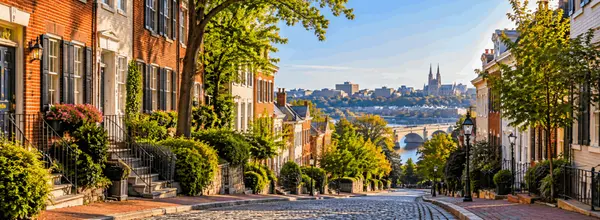
Georgetown East Village vs West Village: Which Side Fits Your Routine?
Choosing between Georgetown's East Village and West Village comes down to the daily experience each address creates, not just the distance between them. In Georgetown, a historic neighborhood in Northwest Washington, DC, a few blocks can change parking patterns, street activity, access to retail, an

Georgetown Resale Market: What Homes Actually Sell For
The Georgetown resale market rewards property-specific comparisons. In early October 2026, the Georgetown neighborhood overview showed a median sales price of $1,182,000 and an average sales price of $1,917,282 for this historic neighborhood in Northwest Washington, DC. Those figures are useful cont

Adams Morgan Luxury Real Estate as Long-Term Investment
Adams Morgan luxury real estate can support a long-term investment strategy when buyers prioritize scarce, well-located homes, durable end-user appeal, and a realistic holding period over short-term cash flow. For this October 2026 guide, "luxury" is an editorial screening threshold of $650,000 and